Medical Checkup Illustration: A Visual Tool for Health Communication
Visual communication plays a crucial role in the healthcare industry, especially when it comes to explaining complex medical concepts to a broad audience. One effective way to convey the idea of a medical checkup is through the use of Medical Checkup Illustration. This type of visual asset simplifies the concept of health assessments, making it more approachable and understandable for patients, educators, and professionals alike.
What Makes Medical Checkup Illustration Unique?
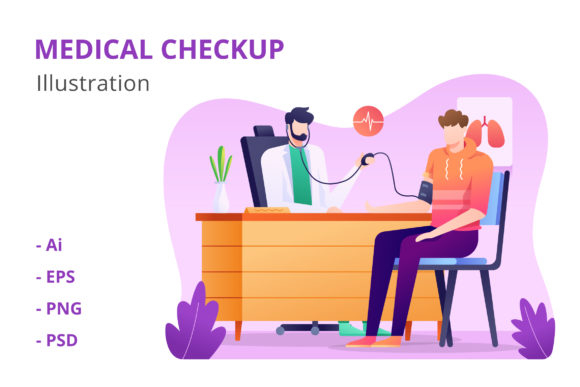
Unlike generic health-related images, a Medical Checkup Illustration is specifically designed to represent the process of medical examination. It typically includes visual elements such as doctors, diagnostic tools, patients, and sometimes abstract symbols of wellness. These illustrations are not just decorative—they serve a functional purpose in making health-related information more digestible.
What sets these illustrations apart is their versatility and clarity. Whether used in a patient education brochure, a mobile health app, or a public health campaign, they help bridge the gap between technical medical language and everyday understanding. Their vector-based format ensures scalability without loss of quality, making them suitable for both print and digital platforms.
Comparing Medical Checkup Illustration with Other Visual Formats
In the world of visual content, there are several alternatives to consider: stock photography, 3D renderings, hand-drawn sketches, and even animated visuals. Each has its own strengths and limitations depending on the use case.
- Stock photography offers realism but may lack the universality needed for broad audiences. It can also be limited in terms of customization and may not always reflect the intended tone or inclusivity.
- 3D renderings provide a high level of detail and realism but can be time-consuming and expensive to produce. They are often overkill for general communication purposes.
- Hand-drawn sketches have a more personal, approachable feel but may not be suitable for professional or clinical environments where a polished appearance is expected.
- Animated visuals are engaging and dynamic but require more technical expertise and may not be compatible with all platforms or audiences.
In contrast, Medical Checkup Illustration strikes a balance between clarity, customization, and cost-effectiveness. Its vector format allows for easy adaptation across different mediums, and its stylized approach often feels more inclusive and less intimidating than real-life images.
Strengths and Tradeoffs of Medical Checkup Illustration
One of the primary strengths of using Medical Checkup Illustration is its adaptability. Since it's vector-based, it can be scaled to any size without losing quality, making it ideal for everything from website banners to mobile app icons. It's also highly customizable—colors, characters, and design elements can be adjusted to match brand guidelines or specific messaging needs.
Another advantage is its broad appeal. The stylized nature of the illustration makes it less clinical and more approachable, which is especially important when communicating with non-medical audiences. It helps reduce the intimidation factor often associated with health-related topics.
However, there are tradeoffs to consider. While these illustrations are excellent for general representation, they may not be detailed enough for specialized medical contexts where anatomical accuracy is crucial. In such cases, photographs or technical diagrams might be more appropriate. Additionally, while vector illustrations are scalable, they may not convey the same emotional depth or realism as photographs.
When to Choose Medical Checkup Illustration
Choosing the right visual format depends heavily on the context and audience. Medical Checkup Illustration is particularly well-suited for:
- Patient education materials where clarity and approachability are key.
- Healthcare apps and websites that need consistent, scalable graphics for icons, banners, and interactive elements.
- Public health campaigns aiming to reach a diverse audience with simple, universal visuals.
- E-learning modules where visual storytelling enhances understanding of medical processes.
For example, a mobile app designed to help users track their health checkups could benefit greatly from using these illustrations to guide users through the process in a friendly, non-threatening way.
When Another Option Might Be Better
While Medical Checkup Illustration offers many benefits, there are situations where other visual formats might be more appropriate:
- Medical textbooks or training materials that require precise anatomical accuracy may need photographs or technical drawings.
- Marketing materials for high-end medical services might benefit from the realism and professionalism of stock photography.
- Interactive simulations or virtual reality experiences may require 3D modeling or animation to fully engage users.
It’s also worth noting that for audiences with high digital literacy or specific visual preferences, a mix of formats may be the most effective approach.
Practical Use Cases and Real-World Applications
One of the most common applications of Medical Checkup Illustration is in digital health platforms. For instance, a telemedicine app might use these visuals to guide users through the steps of scheduling and preparing for a virtual checkup. The illustrations help reduce confusion and anxiety by presenting the process in a familiar, friendly format.
In educational settings, these illustrations are invaluable. A school health curriculum might use them to explain the importance of regular checkups in a way that resonates with students. Similarly, a hospital’s website might use them to visually represent the various services it offers, from routine screenings to specialist consultations.
Another practical use is in public health outreach. Campaigns promoting preventive care, such as annual physicals or vaccination drives, often rely on illustrations to convey their message clearly and inclusively. This is especially important when targeting multilingual or diverse audiences who may not respond as well to text-heavy materials.
Conclusion
In summary, Medical Checkup Illustration is a versatile and effective tool for communicating health-related concepts. It offers a balance of clarity, customization, and accessibility that makes it ideal for a wide range of applications. While it may not be the best choice for every situation, it provides a strong foundation for visual storytelling in healthcare communication. Whether you're designing a patient resource, building a health app, or launching a public awareness campaign, this type of illustration can help you connect with your audience in a meaningful and engaging way.