Food Icons: A Versatile Design Resource for Web and Mobile Projects
Food Icons is a comprehensive icon set designed specifically for use in mobile applications, websites, and digital infographics. It offers a wide range of food-related symbols, crafted with precision and consistency across multiple design styles. Whether you're building a restaurant app, a recipe platform, or a nutrition tracker, Food Icons provides a scalable and flexible visual language that integrates seamlessly into modern UI/UX workflows.
What Makes Food Icons Stand Out?
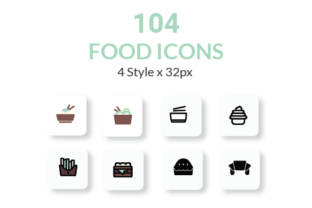
At its core, Food Icons delivers 104 unique icons spanning four distinct visual styles: Line, Solid, Flat Filled, and Pixel. This variety allows designers to choose the aesthetic that best aligns with their project's tone and interface requirements. Each icon is crafted to maintain visual harmony, ensuring that switching between styles doesn't disrupt the overall design coherence.
The icons are designed to be pixel-perfect and consistent in stroke width, size, and alignment. This level of attention to detail is crucial for maintaining a polished and professional appearance across different screen sizes and resolutions. Additionally, the package includes Adobe Illustrator source files, making it easy to modify and extend the icon set as needed.
Why Designers Might Consider Food Icons
Designers and developers often seek icon sets that offer both breadth and adaptability. Food Icons meets this need by providing multiple file formats—SVG, PNG, and EPS—ensuring compatibility across web, print, and application environments. Its support for Adobe XD, Sketch, and Figma makes it a practical choice for teams already invested in these design tools.
High customizability is another key factor. Each icon can be adjusted in color, size, and stroke width, allowing for easy integration into existing design systems. This flexibility is especially valuable for projects that require branding consistency or dynamic theming capabilities.
Key Benefits of Using Food Icons
- Broad stylistic options: The four included styles cater to a wide range of design preferences, from minimalist line art to bold solid icons.
- Cross-platform compatibility: Designed to work seamlessly in Adobe XD, Sketch, and Figma, Food Icons fits into standard UI/UX design workflows.
- Scalable vector formats: SVG files ensure crisp visuals at any size, while PNG and EPS formats support both digital and print use cases.
- Editable source files: The inclusion of Adobe Illustrator files allows for deep customization and expansion of the icon set.
- Free updates: Once downloaded, users receive ongoing updates without additional cost, ensuring long-term relevance and usability.
Tradeoffs and Considerations
While Food Icons offers many advantages, it's important to evaluate whether it's the best fit for your specific project. Since the set focuses exclusively on food-related imagery, it may not be sufficient for applications requiring broader icon coverage—such as e-commerce, transportation, or productivity tools. In such cases, a more comprehensive icon library or a combination of multiple icon sets might be necessary.
Additionally, while the included design files are well-organized, teams with strict design system requirements may need to invest time in integrating and documenting the icons within their existing frameworks. The ease of customization is a benefit, but it also requires a certain level of design proficiency to maintain consistency when modifying icons.
When Food Icons Is a Strong Fit
Food Icons excels in projects where food-related visuals are central to the user experience. This includes:
- Restaurant and menu apps: Visual representation of dishes, beverages, and ingredients enhances usability and engagement.
- Recipe platforms: Icons help categorize and navigate content more intuitively.
- Nutrition and wellness apps: Clear, recognizable icons support quick comprehension of dietary information.
- Infographics and data visualizations: Food Icons provide a consistent visual language for presenting food-related statistics or trends.
In these scenarios, having a cohesive, professionally designed icon set can significantly reduce development time and improve the overall aesthetic quality of the product.
When Alternatives May Be Worth Exploring
If your project requires icons beyond the food category or demands a broader design library, you may want to consider general-purpose icon sets such as Font Awesome, Material Icons, or Feather Icons. These libraries offer thousands of icons across multiple themes and often come with built-in frameworks for easy implementation.
For teams working within a specific design system—like Apple's SF Symbols or Google's Material Design—integrating third-party icons like Food Icons may introduce complexity. In such cases, it's important to weigh the benefits of visual specificity against the need for system-wide consistency.
Practical Insights for Decision-Making
When evaluating Food Icons for your project, consider the following factors:
- Project scope: If food-related visuals are a core component of your interface, Food Icons offers a tailored and cohesive solution.
- Design flexibility: The ability to edit and customize icons is a major advantage, but ensure your team has the tools and expertise to manage those changes effectively.
- Workflow compatibility: Confirm that the included file formats and design tool support align with your existing processes.
- Long-term maintenance: Free updates are a valuable feature, but verify that the provider maintains a consistent update schedule and offers responsive support if issues arise.
- Cost-benefit analysis: While Food Icons is a premium resource, compare its features and licensing terms against alternatives to ensure it offers the best value for your use case.
Conclusion: Does Food Icons Align With Your Needs?
Food Icons is a well-crafted, versatile icon set that caters specifically to food-centric digital products. Its combination of multiple design styles, high customizability, and compatibility with leading design tools makes it a strong contender for mobile and web projects focused on food-related content. However, its niche focus means it may not be suitable for broader applications or highly integrated design systems.
For designers and developers seeking a reliable, scalable, and visually consistent icon solution for food-based interfaces, Food Icons is worth serious consideration. By carefully aligning its features with your project's goals and constraints, you can determine whether it offers the right balance of functionality, flexibility, and long-term usability.